Europe’s Mercosur Gamble: A Historic Breakthrough or the Prelude to Disintegration?

AI Summary
After a quarter-century of anticipation and endless diplomatic friction, the "green light" has finally been given. In early January 2026, the European Union approved the trade agreement with the Mercosur bloc, establishing one of the world's largest free trade zones. However, while hailed as a "historic victory" in the corridors of Brussels, the document is igniting a fire of protests across European streets and farmlands.
Strategic Necessity: A "Third Way" Between the US and China
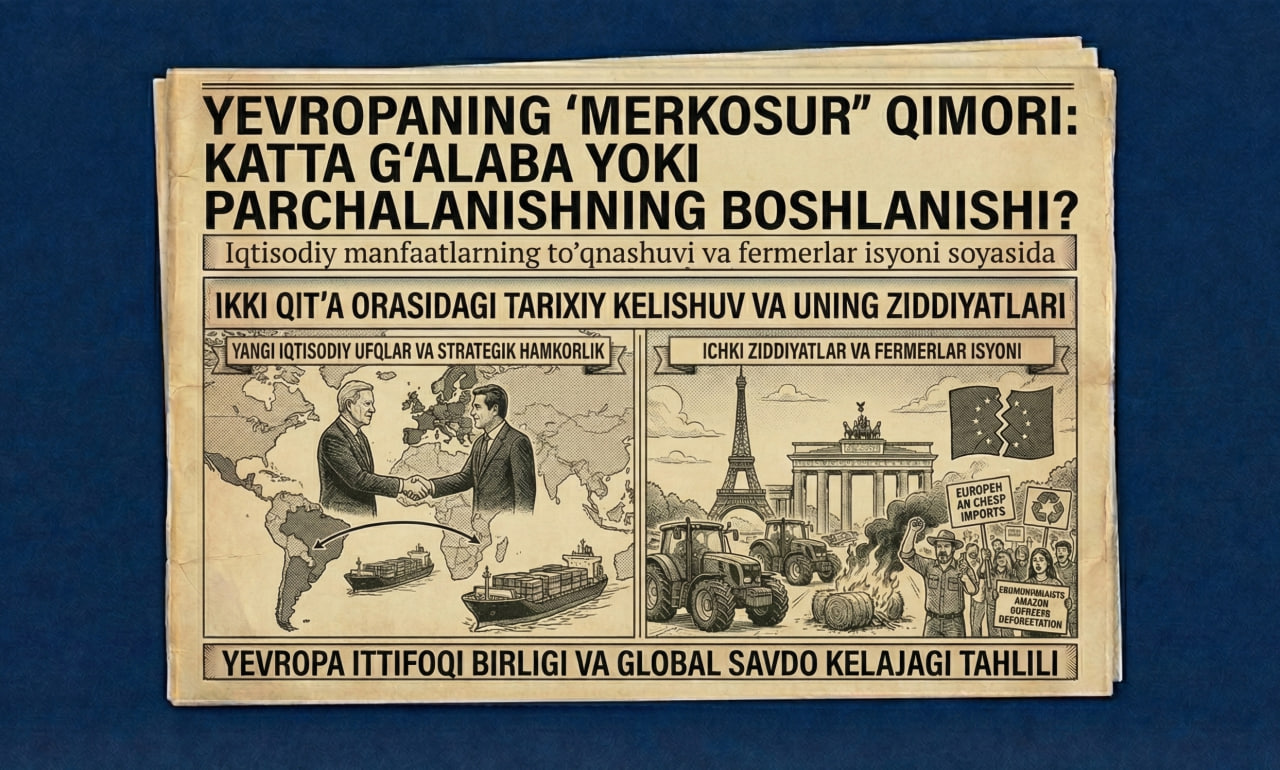
In today's world, trade relations are no longer just about economics; they have become a geospatial (geosiyosiy) weapon. EU leaders, particularly Ursula von der Leyen, view this agreement as proof that Europe is forging its own path. Amidst high tariffs imposed by Washington, this market of 780 million consumers is a matter of survival for the European automotive and pharmaceutical industries. Furthermore, it represents a "soft" distancing from Beijing, which is currently South America's primary trading partner.
A Cheap Victory: What is the Price of 0.05 Percent?
Although the deal eliminates over 90% of export tariffs, economic forecasts remain surprisingly modest. The European Commission estimates that by 2040, the agreement will increase the bloc's GDP by a mere 0.05% (approximately $90.2 billion). Such a low figure is attributed to the historically low volume of trade between Europe and Mercosur members. This raises a critical question: is Europe willing to jeopardize its internal stability for such negligible economic gain?
Internal Fragmentation: The Alliance of Farmers and Environmentalists
The most vocal opposition comes from European farmers, the "guardians of food security." They fear that cheap South American beef and poultry will flood the market, driving local producers into bankruptcy. Environmental groups also argue that production standards in South Africa do not align with EU requirements, citing deforestation and uncontrolled pesticide use as major concerns that tarnish the "green image" of the deal.
Political Earthquake: Macron’s Government on the Brink
The agreement has also politically split Europe. Nations like France, Poland, Austria, Hungary, and Ireland voted against the document. Italy, however, changed its stance at the last minute in exchange for a promised $52 billion aid package for its agricultural sector. The situation is particularly dire in France, where Emmanuel Macron’s government faces a potential vote of no confidence as a new wave of farmer protests takes to the streets.