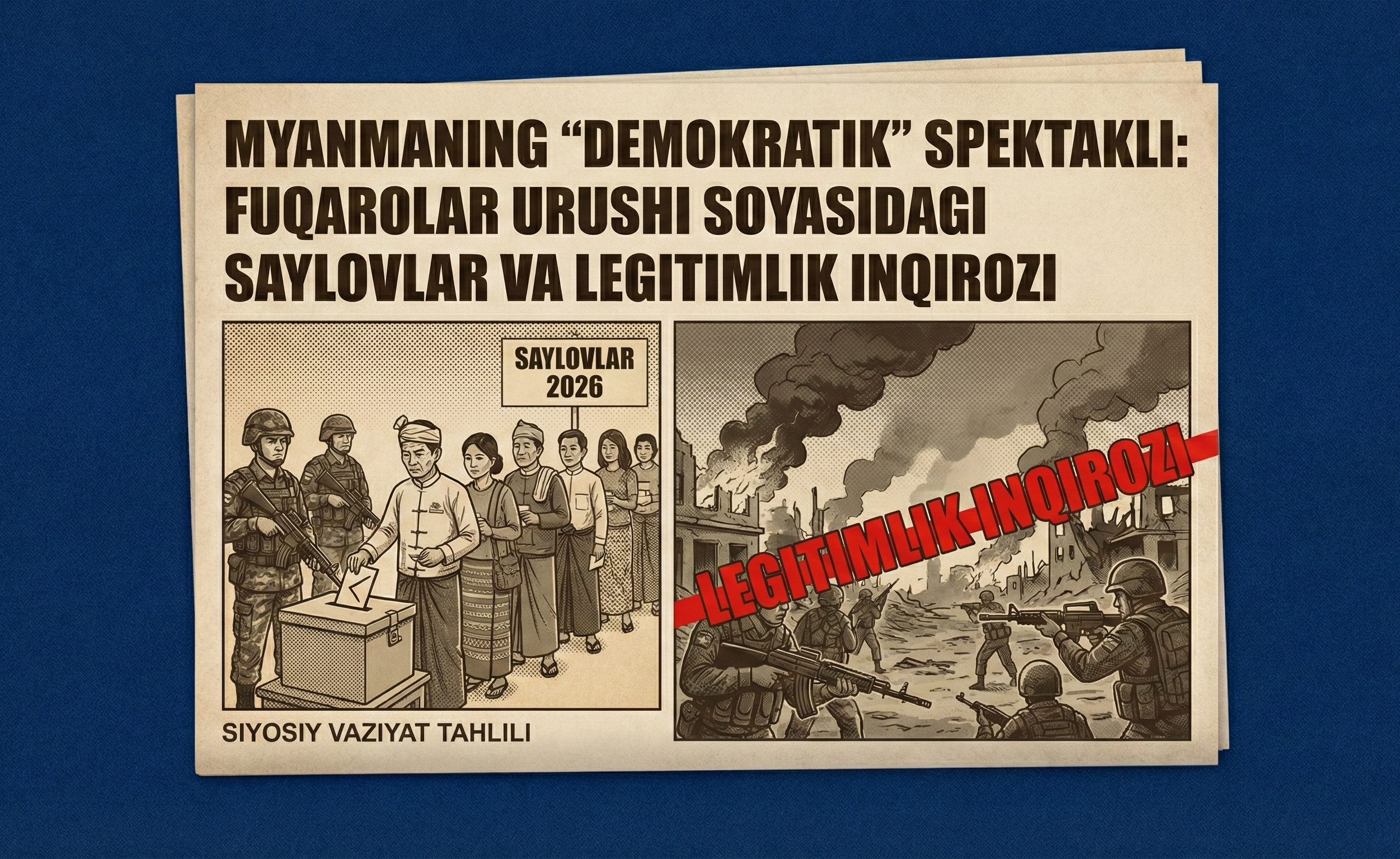
Myanmar’s “Democratic” Spectacle: Elections in the Shadow of Civil War and a Crisis of Legitimacy

AI Summary
Myanmar’s military junta recently announced the completion of the first phase of its three-stage general election. Junta spokesperson Zaw Min Tun claimed a turnout of 52.13%, representing over 6 million voters. While the military administration frames this as a "source of pride," the figures pale in comparison to the ~70% turnout of the 2015 and 2020 democratic elections, highlighting a massive decline in public trust.
A Geopolitical Spectacle and Global Skepticism
These elections, the first since the 2021 military coup, are taking place amidst a brutal and ongoing civil war. The international community, including the United Nations and Western nations, has dismissed the process as "neither free, fair, nor credible." The reasons are stark: opposition parties have been banned, and criticizing the electoral process has been criminalized. This is widely viewed as a "geopolitical spectacle" designed to manufacture a facade of legitimacy.
Fragmented Control and "Gray Zones"
The situation is underscored by the dissolution of the National League for Democracy, which won a landslide in 2020, and the continued detention of Nobel Peace Prize laureate Aung San Suu Kyi. The junta has scheduled the remaining phases for January 11 and 25, 2026. However, with large swaths of the country still outside military control, the election map is riddled with "gray zones"—areas where no voting can realistically take place.
Conclusion
The "political experiment" in Myanmar serves as a textbook example of how a democratic facade can be weaponized to maintain power. As we observe the regional stability of Southeast Asia in 2026, it is clear that true victory is not found in ballot boxes filled by decree, but in the genuine trust of the people—a resource the current regime lacks entirely.