"Dove of Peace" or "Political Advance"? Presidents Who Won the Nobel Prize and the Heavy Burden of the "Gold Medal"

AI Summary
It was 1888 when the French press committed a blunder that would change the course of history. They published an obituary for the inventor Alfred Nobel, who was very much alive at the time. The headline was short, brutal, and damning: "The Merchant of Death is Dead."
Reading his own grim description, the inventor of dynamite was horrified. He could not bear the thought of entering history branded merely as a "bloody millionaire." Desperate to cleanse his conscience and redeem his legacy in the eyes of humanity, he established what has become the world's most prestigious accolade.
Yet, in a twisting irony of history, this prize—born from the pangs of a guilty conscience—has today morphed into something else entirely. Too often, it serves as a tool for purchasing conscience, a geopolitical signal, or a method to "legitimize" high-stakes political games.
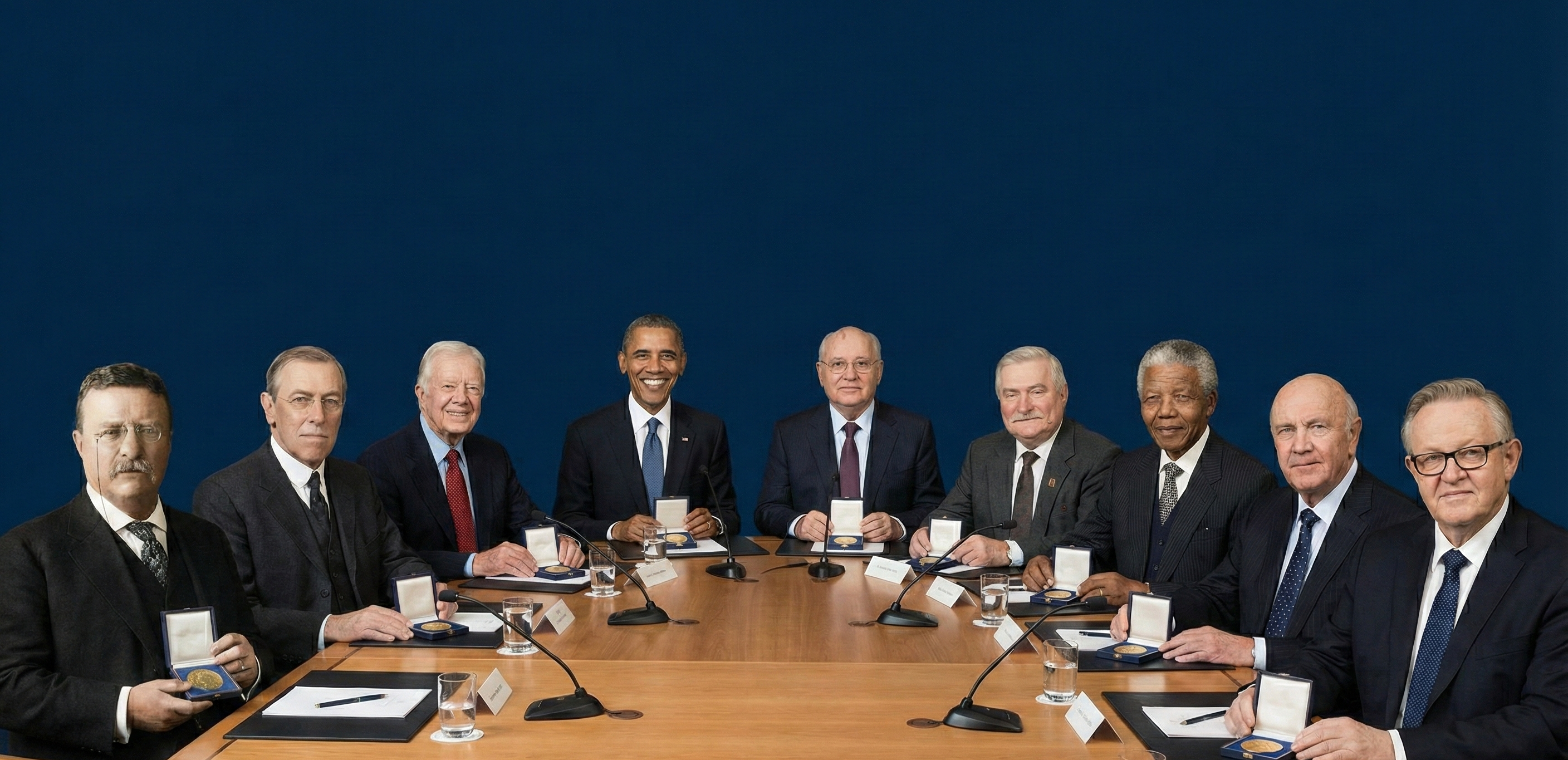
Today’s analysis focuses on a specific paradox: Heads of State who carry the nuclear codes in one hand, command powerful armies with the other, yet wear the title of "Peace Laureate" on their chests. What are we really looking at here? Is it a triumph of humanitarianism, or, as we have previously discussed, another expensive spectacle on our global "Propaganda Battleground"?
Theodore Roosevelt: The "Big Stick" and the Realpolitik of Oslo
Let us begin our historical audit with the 26th US President, Theodore Roosevelt (1906 Laureate). On the surface, the narrative is clean: he was applauded for mediating the end of the bloody Russo-Japanese War.
But flip the medal over, and the metal is cold. It was this same Roosevelt who authored the infamous "Big Stick ideology." His geopolitical philosophy was simple and unashamed: "Speak softly and carry a big stick."
An imperialist who viewed Latin America as his personal "backyard" and forcibly carved the Panama Canal zone out of a sovereign state is hailed as an "Ambassador of Peace." This moment marked the first time the Nobel Committee in Oslo capitulated to "Realpolitik"—the politics of raw power and national interest—over genuine humanitarian ideals.
Here, we observe a classic manifestation of what I call "Humanitarian Defeat": The Peace Prize became a "bonus" awarded not for protecting the weak, but for maintaining a convenient balance between the strong.
Barack Obama: The Political "Advance" and the Drone Wars
Fast forward to 2009. Barack Obama had occupied the Oval Office for a mere nine months. He had stopped no wars. He had signed no global strategic treaties. He had barely warmed his chair. Yet, the Nobel Committee handed him the Peace Prize.
Why? The answer is simple and regrettable: It was a "Political Advance."
After the aggressive unilateralism of the George W. Bush era, the European political elite was desperate for a rebrand. They needed the image of a leader who spoke eloquently and promised liberal values. They were not rewarding Obama the man; they were pinning a medal on their own illusions of the "American Dream."
But what was the reality? In the era of "Peace Dove" Obama, the US military escalated drone strikes in Pakistan, Yemen, and Somalia tenfold. Thousands of civilians perished, dismissed under the cynical military euphemism of "collateral damage." Libya was bombed into anarchy; Syria sank into a bloody quagmire.
Obama’s Nobel remains history’s greatest achievement of Western propaganda—and simultaneously, its most glaring contradiction.
Mikhail Gorbachev: Hero to the West, "Gravedigger" at Home
The most painful point for our region remains the 1990 Laureate, Mikhail Gorbachev. In the eyes of the West, he is the Messiah who tore down the Iron Curtain, ended the Cold War bloodlessly, and dismantled the Berlin Wall.
But ask millions of people across the post-Soviet space, and you hear a different story. To them, he is the weak leader who allowed the uncontrolled disintegration of a superpower, abandoning his people to the abyss of economic chaos, starvation, and brutal inter-ethnic conflicts (from Karabakh to Fergana, Osh to Tbilisi).
In this context, the Nobel Prize was not a recognition of peace; it was the West's "Thank You" note to Gorbachev. It was a reward for the elimination of a geopolitical rival. To deny this is to deceive ourselves.
Aung San Suu Kyi and Abiy Ahmed: The "Fallen Angels"
The most shameful chapters in Nobel history were written in the recent past, accelerating the devaluation of the prize.
Aung San Suu Kyi (Myanmar): For years, she was canonized as a saint of democracy, the "Asian Mandela," winning the Nobel in 1991. Yet, once in power, she turned a blind eye to the genocide of the Rohingya Muslims, even defending the military's atrocities at The Hague.
Abiy Ahmed (Ethiopia): Awarded in 2019 for a peace deal with Eritrea, this young leader was hailed as a visionary. Less than a year later, he launched a brutal war against his own people in the Tigray region. Under the orders of a Nobel Laureate, starvation was weaponized.
These cases confirm the thesis we advanced in our previous article, "Battle on the Propaganda Battleground": The West creates "convenient" avatars, elevates them to the heavens, but when harsh reality surfaces, it takes no responsibility for the monster it helped dress in saint's robes.
Conclusion: The Glittering Medal and the Bitter Truth
My dear compatriot, my intellectual contemporary. The Nobel Peace Prize is not a divine seal of moral quality. It is a subjective political decision made by five Norwegians in a room in Oslo. Sometimes they use this "soft power" to try and stop a war (as a down payment), and sometimes to promote their own ideological dogmas. The conclusion for us is this: True peacemaking is not manifested at black-tie banquets in Stockholm or Oslo. It is found in the well-being of ordinary families, the security of our borders, and the sovereignty of our state. Judge a politician not by the medal on their chest, but by the bread on their people's table and the confidence in their eyes. For if Alfred Nobel invented dynamite, modern politicians, hiding behind the mask of "Peace," are detonating a far more dangerous explosive substance: "Mistrust." And our task is to keep our minds sharp and our reason intact within the blast wave of this explosion.